Let’s lose them

Have you ever been lost in a book?  Of course you have; we all have.  Have your students ever been lost in a story in class or a reading?  Do they get so caught up in the humor or the wonder of what will happen next that they FORGET that they are learning (acquiring) language?  I imagine it has happened in your class.  I know it happens occasionally in mine.  Maybe it should happen more.

As I’ve been writing and creating materials for class recently, I’ve started to move away from a focus on recently covered structures and towards a focus on compelling stories.  Then I read this article by Stephen Krashen:

The Case for Non-Targeted, Comprehensible Input

The article itself is very intriguing, and the timing of its publication along with my recent focus made it especially relevant to me.  In the article, Krashen describes the disadvantages of a grammatical syllabus and the effectiveness of compelling input for language learners.  (I won’t waste space summarizing it here.  Click the link above to read the entire article.  If you’re like me, you’ll read it a few times and mark several places for future reference)  Among many other lessons, this article confirmed that my recent thoughts about a focus on compelling material are valid and shared by others.

In the past, I would take a few structures that were, by a textbook or frequency list, deemed important and try to create a compelling story based on them.  Sometimes it works, and sometimes it does not.  What happens when you get to the end of a “unit” and your remaining structures are she was spoiled, she used to play with puzzles and stop laughing at me?  How do you force them into an interesting story?  Sometimes it’s impossible.

Now, I tend to start by creating a compelling story line.  “Ooh . . . what if a magical frog started granting wishes to children . . . but the children never granted his one wish of having a real friend . . . so he ate them?”  It’s very liberating when the focus changes from, “Let’s read to get repetitions of certain terms” to “Let’s read to get better at reading.”  And the same is true for listening, speaking and writing.

Near the end of the article, Krashen gives advice to those of us who are writing/creating materials.  He tells us to . . .

  1. create readings that are not targeted at certain structures and vocabulary
  2. focus on making the text interesting and comprehensible
  3. remember that if the students understand the text (and like it), then the text is appropriate

So, let’s do that.  Let’s lose our students in compelling stories, readings, jokes, magic tricks and movie talks.  Let’s allow them to effortlessly acquire language as we encourage them to forget they are doing anything other than wondering what will happen next.

 

Posted in Reading, Reflections, Writing | 3 Comments

Gotitas de Amor (an embedded reading unit)

Here’s a Spanish embedded reading unit based on the song “Gotitas de Amor” by Jesse y Joy.  I created a source sheet to which all documents/presentations/activities are linked.  I will also paste the information below.  I was very pleased with this unit and my students’ engagement with it.

Gotitas de Amor – Embedded Reading Source Sheet

gotitas de amor

An embedded reading unit based on the song “gotitas de amor” by Jesse and Joy prepared by Bryan Kandel

Song – gotitas de amor

1. Introduce unit and song title.  

2. Project entire song and read aloud:

Slide 2 of gotitas de amor presentation

3. Introduce vocabulary for base version of the song.  Engage in personalized discussion (PQA) based on new terms.

Slides 3-7 of gotitas de amor presentation

Structures:

te quiero regalar
cuida
lindo(a)
gotitas de amor

4. Create in-class story based on new terms.  The story can be brief because extra reps will occur with the various readings of the text.  Story can be about a character who has a very pretty pet and takes great care of it and sprinkles it with drops of love.  He/she gives it to a boyfriend/girlfriend who does not take care of it.  

5. Read base version of the song.  Read several times and translate so meaning is very clear to all students.

Slide 8 of gotitas de amor presentation

6. Complete bellwork based on base version vocabulary.

Slide 10 of gotitas de amor presentation

7. Introduce vocabulary for version 2 of the song.  Engage in personalized discussion.  Use photos for extra practice.  

Slides 11-19 of gotitas de amor presentation

Structures:

tengo que decirte
riega
perdió
espinas
quiero que crezca

8. Play “don’t smile” game with the phrase “tengo que decirte que te amo”.

Slide 18 of gotitas de amor presentation

Description of “don’t smile” here: no puedes sonreír

9. Read version 2 aloud.  Clarify any confusing parts.  

version 2 of gotitas de amor

10. Distribute written copy of version 2 to all students with a different voice/personality listed on each.  Students must read the song to a partner in their assigned voice.  Volunteers can read aloud to class afterward.  

Examples:

sad voice, angry voice, like a robot, like a baby, Batman, tired voice, excited, cold, scared . . . etc.

11. Distribute final version activity.  Read aloud.  Discuss new terms that are defined on document.  Possible discussions for “para que” subjunctive constructions.  

final version of gotitas de amor

12. Google Voice read.  Students call Google Voice number and read the song aloud.  Found on back of final version of gotitas de amor

13. Drawing.  Students draw pictures to represent given sections of the song.  Found on back of  final version of gotitas de amor

14. Sing.  

Slides to sing with guitar: canciones

Lyric video: gotitas de amor

15. Watch live versions of the song.

16. Running dictation based on new structures.  Print the document below and hang it outside of class.  Working in groups of 2, students must copy the exact paragraph onto a paper in the classroom.  To do so, one student must go look at the paper out of class, remember as much as possible, go back into class and tell his/her partner.  Students can go in and out as many times as necessary to get the text.  

gotitas de amor – running dictation

Posted in Embedded Reading | 2 Comments

Closers

What happens when students finish an assessment and there are 10 minutes remaining in class?  Or when the internet goes out, or for some other reason, you cannot do what you had planned in class?  Or your first activity took longer than expected and you do not have enough time for the next task?  Here are some 5-10 minute activities that take no prep and can be used at any time.  (Some may require a few minutes of prep the first time but are then available for future use.)  Most are quick games.

Music: Have a database or list of youtube lyric videos that can be watched and/or sung.  Here are some slides with links that I use in Spanish class.  The first page is a list of songs that we sing with the guitar.  The second is a list of video based songs that we’ve seen this year.  It grows as the year progresses.

Canciones

100 Game: A simple game to practice numbers.

Discussion: Talk about plans for after school today.  Have students discuss what happened yesterday in groups.  Have a cup with random questions/topics that can be selected and discussed.

Vocabulary Tennis game: A simple, no-prep game to practice vocabulary in categories.

Who am I?: Play it as a class or bring up 3-5 students to play in front of class.  Another variation is to have the teacher guess who he/she is.

Basurabol:  A game that can be played without any preparation.

Don’t smile: A quick, fun way to get many reps out of a desired structure.

True or False: A fun (sometimes violent) game based on statements in the target language.  No prep needed.

Circumlocution practice:  Make a powerpoint presentation with 5 words in English (L1) on each slide.  They should be words that are unknown in the target language.  Put one student in a chair facing away from the screen (the hot seat) and project a slide.  The teacher describes the terms in the target language and each student tries to guess as many as possible in English in 2 minutes.  Keep track of fastest times somewhere in the room.  Requires some time to prepare the slides, but they are always available afterward.  Here is one of my files with 5 terms per slide:

hot seat 


Posted in Classroom activities, Games | 1 Comment

Mad Libs – CI style

Here’s a slight variation on storytelling if you feel you need a change-up in the routine.  In a “Mad-Libs” style, students provide the details for a story without knowing how they will fit until the story comes together.  You can use my model or adjust it for a different set of structures.  I’m sure I will come back to this again.

1. Project a numbered list of terms you need for the story (a person from class, a food, an adjective, an animal . . . etc.)

Here is my list: Mad Libs List

2. Solicit class input for each item.  The teacher writes on the screen/board while one volunteer students makes a list on paper.

3. Project the story with numbered blanks.  Each  number corresponds to the list the class has created.  The volunteer student reads off the items on the list, and the teacher (or another volunteer) inserts them into the corresponding blanks of the story.

Here is my story that corresponds to the list above: Mad Libs Story

4. Read the story, act it out, question, circle . . . etc.

*One variation would be for each student to write his/her own list for step #1.  You would have many different stories.

Posted in Stories/Storytelling, Story activities | 2 Comments

A few new twists on an old favorite

We’ve been working with “El abrigo anaranjado“, which is an embedded reading I created based on Julio Cortázar’s “Continuidad de los parques”.   I’ve taught this reading a few times in the past, and I really enjoy it.  This time, I tried a few new wrinkles on the lessons.

1. Google Voice – After reading the third and final version of the story, I distributed this sheet to students.  They each called and read the sentences with the correct words.   It took under 5 minutes.  I’m really starting to like using Google Voice for quick comprehension checks.

2. Video – After reading all versions of the story, we watched this video.  It is different than my version and slightly different than the original, which provided for good discussions about differences.


Posted in Assessment, Classroom activities, Communicative Activities, Embedded Reading | 1 Comment

Don’t you dare . . .

As I prepare for an upcoming workshop presentation, I thought I’d share a few notes here regarding the incredible opportunity we have as language teachers.  This is probably not a new idea for anyone reading this page, but it may be a welcome reminder at the start of a new week.  Here goes . . .

A simple yet very important rule for teaching languages.

DO NOT EVER allow your world language class to be “just another class”.  Something insignificant that occurs between Algebra and lunch.  A place where students sit through the same monotonous cycle (lecture, textbook, chart, worksheet, homework, study, test) as they see five times every day in other classes.  Believe it or not, it happens.  I know because it used to happen in my classroom, and I was content with it.  Now, it drives me mad.

Be different.  Create an environment where students know they will be engaged for 45 minutes.  They have no choice.

Many will love our classes.  A few (usually those who are very closed to other cultures) may hate them, but it should be impossible for anyone to be indifferent.  As they look at their daily planner, Spanish/French/Chinese/German/Japanese should stand out and make them wonder, “What will we do in there today?”  As language teachers, we are lucky.  We get to . . .

  • tell jokes
  • sing songs
  • make up wacky stories about people falling in love with ducks
  • discuss students’ interests, goals, families, fears, problems, opinions
  • build lessons around the students
  • tweet videos of Spanish versions to Miley Cyrus songs and pictures of Barack Obama without a shirt and playing the trumpet
  • wear wigs
  • play games
  • encourage talking on the phone and texting in class
  • perform magic tricks
  • make Super Bowl predictions
  • draw
  • make animal noises
  • pretend like a $3.49 light from Home Depot actually has magical powers to punish those who speak English
  • run in the hallway
  • laugh every period of every day
  • talk to a mind-reading genie
  • dance
  • do very bad impressions
  • play with puppets and dolls
  • read poems
  • make cartoons online
  • look every student in the eyes every day
  • see evident and obvious growth
  • give unannounced assessments and be constantly impressed by the results

And the beautiful part is that all these activities are not only permissible within our content standards, but they actually increase our students’ chances of success.  Language is alive.  There is no excuse for a dead class.


Posted in Reflections | 2 Comments

La tienda de mascotas (Story Script, Reading, Movie Talk)


A story, a reading and slides for Movie Talk based on a pet store, annoying talking animals and big ears.  Materials are in Spanish.

Un mascota nueva: This story script can be “asked” in class.  The story involves a man who is tired of his current pets and wants to try a bird as a pet.  Unfortunately, the birds he brings home cause many problems.  Key terms: fue a la tienda de mascotas (went to the pet store), quería comprar un pájaro (wanted to buy a bird), lo llevó a la casa (took it home).

El pájaro hablante: This reading tells of a pet store worker who nurses a sick bird back to health and gains a best friend.  However, the bird’s jealousy becomes a problem when he tries to maintain a social life with the ladies.

Se vende ratón: Freeze frame slides and a collage for Movie Talk with an animated video called “Mouse for Sale”.  Special thanks to Christy Miller for suggesting the video and helping to plan Movie Talk.  Check out here extensive database for Movie Talk videos here:

Movie Talk Database

Posted in Movie Talk, Reading, Stories/Storytelling, Story Scripts | 4 Comments

Story Game

photo (2)

Here’s a game I tried last week.  I’ll explain the rules and how we “played” it for the first time.  Then, I’ll share some of my reflections for how it could be improved or adapted.  I would be very interested to hear input from others, so if you are looking for a story-based game, try this and let me know your thoughts.

The game is adapted from a game called Once Upon a Time.  There is actually a Spanish version to Once Upon a Time, but I wanted something simpler and with a wider range of high frequency vocabulary.

There’s not much to the game pieces, but there are several variations for how to play.  I started by creating cards with story elements in Spanish (characters, actions, descriptions, places).  They can be found here:

Cuentos – cards

I printed the pieces onto cardstock and cut them out.  I gave 6 to each student and put them in groups of 3-5.  I had in mind several versions of the game that range from simple to complex.  We tried the first few in class.  The more complex versions would be the most effective, but they may only be possible with small classes and/or advanced students.

Version 1 (easiest): Within the group, each student makes a story out of his cards and shares it orally to the group.  The group votes on the most interesting.

Version 2: Groups work together to build a story out of all their cards.  The first group to create a story of at least 12 cards and tell it to the teacher wins.  Variation – The most interesting story wins.

Version 3:  Students work together in the group to create a story.  Play begins with one student and then rotates around the circle.  Students can play or pass at each turn.  If they have no play, decide to pass or use English, they forfeit their turn.  The first student to run out of cards wins.  He/she must tell the entire story to the teacher to receive a prize.

Version 4 (most similar to the original version of Once Upon a Time): Similar to version 3, but the order does not necessarily move around the circle.  One student begins the story.  Other students can take over at any time.  Another player takes over when the current storyteller uses a term that matches a card he/she has in hand.  Another player can also take over at any time by playing a “me toca a mí ” interruption card.

Notes:

* Students should be encouraged to keep the story in third person.  Action cards have two forms (singular and plural).

*Students are permitted and encouraged to add as much as they want between cards that they play.

*The main objective is for students to put together stories.  It is not for them to spend time thinking about structure.  If students have cards they do not understand, allow them to exchange for terms with which they feel more comfortable.  Give students (print or projected) useful connector words or story builder words.

*After playing any version of the game, students could be asked to write their final story or share it with others.

*The cards could also be used for free writing.

*Some students/groups did better than others at creating interesting stories.  The best groups added much between each card while other groups simply combined several cards into one long sentence.  I am considering the most effective ways to promote the former and would welcome any ideas.

Posted in Classroom activities, Communicative Activities, Games | 8 Comments

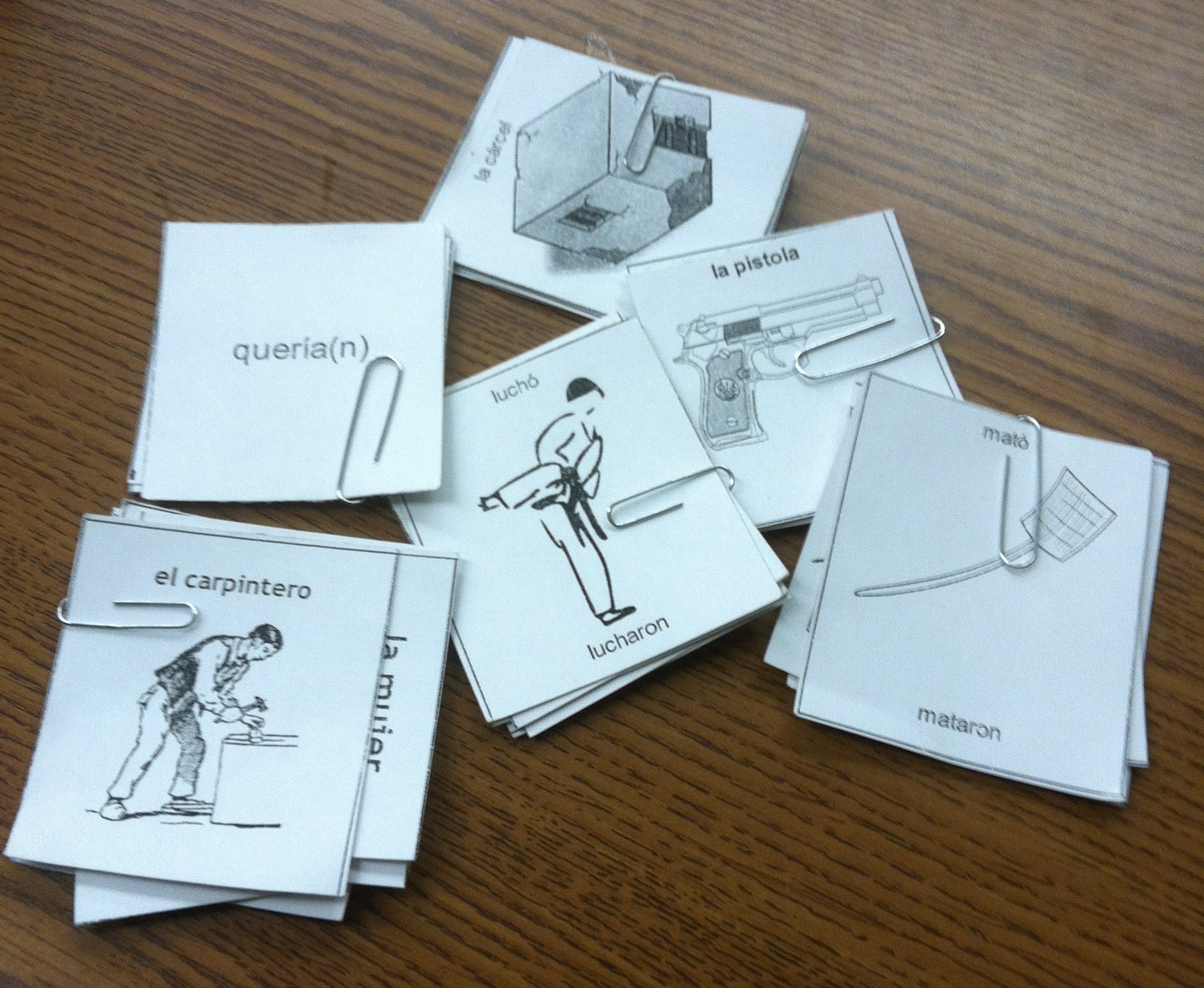
El hombre inocente: an embedded reading

Here’s an embedded reading in Spanish about an innocent man in prison and his attempt to escape.  I started with the following presentation of new terms and the base version of the reading:

El hombre inocente – vocabulary and base version

We read and translated the base version to be sure everyone understood clearly.  Then, I distributed a written form of the base version to students and asked them to change something or add something to each sentence.  I was surprised and impressed by their creativity.  I enjoy the change/add activity because it exposes students to the text again (input) and allows them small chunks of output practice.

The last step is to read the complete final version.  I only created two versions for this text because there was not much new vocabulary or incomprehensible material, but it would be possible to create a second version between the base and the final.

The document with the final version and the base is linked below, and the text for the final is pasted as well.

El hombre inocente – Base and Final text

El hombre inocente

Había un hombre que se llamaba Larry Johnson.  Estaba en la cárcel en Guatemala, pero era inocente.  Quería escaparse de la cárcel.  Tenía que escaparse de la cárcel.

Larry era de Denver, Colorado pero fue a Guatemala para aprender el español.  Quería pasar un año viviendo en Guatemala.  Después de año, quería volver para ser profesor de español en los estados unidos.  Estaba estudiando con una mujer guatemalteca que se llamaba Gloria.  Era bonita e inteligente y sabía un montón de idiomas.  Larry estaba enamorado de ella.

Un dia, Larry entró el apartamento de Gloria para su clase de español y la encontró muerta en el suelo.  Alguien la mató con un cuchillo.  Larry llamó a la policía.  Un policía llegó y capturó a Larry.  Creía que él tenía la culpa por la muerte de Gloria.  En realidad, Larry no tenía la culpa.  Estaba enamorado de Gloria.  No la mató.  Larry trató de explicarse al policía, pero no lo creía.  Lo puso en la cárcel por 14 años.  

Larry llevaba siete meses en la cárcel y estaba harto de la vida adentro.  Además, recibió una carta mala:

Hola Larry,

Sé que tú no tienes la culpa por la muerte de Gloria.  Yo tengo la culpa.  Yo la maté.  Te iba a matar a ti tambien pero no estabas con ella.  Quería matarlos porque tenía celos.  Estaba enamorado de Gloria, pero ella estaba pasando mucho tiempo contigo y no conmigo.

Yo sé que tú estás en la cárcel y que eres prisionero #561329.  Tengo “amigos” en la cárcel.  TE VAN A MATAR.  

Dulces sueños,

     Un admirador secreto

Por eso, Larry tenía que escaparse.  Tenía un plan.  Primero, le escribió una carta a su abuela:

Querida abuela,

Estoy en la cárcel en Guatemala.  Había un error.  No tengo la culpa.  La comida aquí es horrible y tengo mucha hambre.  Por favor, mándame tus galletas famosas.  Puedo comerlas y venderlas a otros prisioneros por cigarillos y champú.  Gracias.  Te amo.

Tu patito,

       Larry

La abuela recibió la carta y le mandó las galletas a Larry.  

Segundo, Larry fue a la cocina de la cárcel y encontró el veneno de ratas debajo de la refrigeradora.  Puso el veneno en una de las galletas de su abuela y fue a su celda para esperar.  Cuando un guarda pasó, Larry sacó las galletas y empezó a comer.  El guarda vio las galletas y habló con Larry:

Guarda: ¿Que tienes?

Larry: Nada

Guarda: ¿Tienes galletas?

Larry: Sí.  Son las galletas especiales de mi abuela.

Guarda: Dame una galleta.

Larry: No.  Son mías.

Guarda: Por favor.  Tengo hambre.

Larry: Pues . . . sólo una.

El guarda sacó sus llaves, abrió la celda y entró.  Larry le dio una galleta.  Por supuesto, le dio la galleta con el veneno de rata.  Larry comió una galleta tambien, pero la suya no tenía el veneno.  Después de comer la galleta venenosa, el guarda se cayó muerto.  Rápidamente, Larry se quitó su ropa y quitó la ropa del guarda.  Se puso el uniforme del guarda y puso su uniforme de prisionero al guarda muerto.  Con las llaves del guarda, abrió la puerta de la celda y salió.  

Larry caminó por la cárcel, salió por la puerta principal, entró un carro de policia y manejó a Nicaragua para empezar una vida con una identidad nueva.  Nadie sabía la verdad.  En la cárcel, los otros guardas encontraron a prisionero #561329 muerto en su celda.  Creían que era Larry y no les importaba para nada.   

Hoy, Larry vive en Managua, pero no es Larry Johnson.  Se llama Larrio Juanhijo.  

Posted in Embedded Reading, Reading | 3 Comments

Reading Homework

Here’s an activity I assigned recently to be completed out of class.  I wanted to utilize the many stories I had created from past years that would otherwise go unused.  I chose and printed about 30 readings from my TPRS Readings Database.  I distributed them to each class.  No two students in any class had the same text.  I did my best to assign more difficult texts to stronger students and easier texts to those who struggle with reading.  I also gave them the following sheet to be completed:

Reading Homework 

The tasks are also listed below without space between for writing.  I do not typically assign writing to be completed outside of class.  In the future, I may have step #10 completed in class.  I plan to use this activity again.   Next time, I will assign authentic texts instead of my own stories.  I am excited about the potential of this type of reading activity.

Reading Homework #1

1. Read the entire story.  There may be parts you do not understand, but do not stop.  Read the entire story to try to get a basic understanding.  Fill in a percentage below.

       During the first reading, I understood _______ % of the story.

2. Write a paragraph of at least 5 sentences in English that summarizes the story based on your first reading. (5 points)   

3. Answer the following questions. (2 points)

A. What point of view does the author use? (1st person, 2nd person, 3rd person)

       B. In what tense is the story written? (present, past, future)

4. Write at least one Spanish word and its definition that you did not know before reading the story but learned from using the context. (2 points)

5. Make a list of at least 5 words from the story that you do not know.  Use resources (dictionary, internet, teacher) to find English definitions and write them beside the new words. (5 points)

6. Read the story again.  Using the new definitions, you should be able to comprehend 100% of the story.  If there are parts you still do not understand, ask your teacher.  

7. IN YOUR OWN WORDS, write a 5 sentence summary in Spanish of the story. (5 points)

8. Translate the entire story to a parent and ask him/her to sign below (5 points):

              My son/daughter _________________________________ translated the Spanish story to me.

                Signature and date: _______________________________________________

9. Write 10 comprehension questions about the story IN SPANISH.  Use the question words to help you (¿Qué? ¿Dónde? . . . etc). (5 points)

10. Writing extension:  Choose one of the following options and write at least 100 words in Spanish. (15 points – 5 completion, 5 comprehensibility, 5 accuracy).  

     A. Change point of view – Rewrite the first 100 words, changing from 3rd person to 1st person or 1st person to 3rd person.

     B. Write a new ending.  Change the story from whatever point you’d like.

     C. Continue the story.  Write what happened next.

     D. Choose a secondary character (not the protagonist) and write more about him/her and what he/she did.

     E. Rewrite the first 100 words and add something or make a change to every sentence.   

Posted in Homework, Reading | 8 Comments