Thoughts on effort vs. performance

Recently, I had an interesting conversation with a student regarding her grade in another class.  It illustrates the mindset that I am trying to change as I move towards more performance based assessments.  More on my assessment ideas and goals later.  For now, here’s how the conversation went:

Student: Ah! I can’t believe the teacher is giving me a C in art for this quarter.  It’s not fair.

Me: Are you good at art?

Student: Well . . . no.

Me: Then why should you get a good grade?

Student: Because I try hard.

I forget exactly how the rest of the conversation went, but I’m pretty sure I did not convince her that a “C” is fair if she is not able to perform well in art.  I have two problems with her comments.  First, why should effort alone result in a good grade?  Hard work is important.  It’s what guides students to the necessary abilities to perform and succeed.  As teachers, we should motivate students to work hard.  But why should that be part of assessment of them?  We should assess their abilities.  What can they do?

My second issue is with the definition of “trying hard”.  Often, students (and sometimes teachers) have a skewed view of what “trying hard” is.  Doing required assignments is not trying hard.  Being in class is not trying hard.  In my mind, genuine effort to improve involves going beyond minimum requirements.  It is complete engagement in class and seeking extra opportunities for input and practice outside of class.  For Spanish, it is reading outside of class, reading aloud to improve flow, finding opportunities to speak with        native speakers, extra vocabulary or grammar work.

And the result of genuine “trying hard” is almost always improved abilities.  Improved performance.
Posted in Assessment | Leave a comment

Story Script – Nunca te olvidaré

Nunca te olvidaré

encontró a su alma gemela –  he/she found his/her soulmate

tuvo que irse – he/she had to leave

“nunca te olvidaré” – I will never forget you

PQA ideas:

  1. What did you have to do yesterday? (Tuve que . . . )
  2. Who had to . . . ? (local and celebrity)
  3. Listen to “Nunca te olvidaré” by Enrique Iglesias.
  4. Discuss soul mates.  Who has found one? Do they exist?  Describe yours?
  5. Verb forms and tenses for olvidar, tener and encontrar
  6. View and discuss the following links about McDonalds failing and being forced to leave Bolivia. (Tuvo que irse de Bolivia).  Cultural discussion and analysis could get deep.

http://www.atrio.org/2012/03/mcdonald-fracaso-y-tuvo-que-irse-de-bolivia/

http://www.revistapym.com.co/destacados/bolivia-unico-mercado-latinoamericano-que-fracaso-mcdonalds-que

Story base:

Había un hombre que se llamaba Chuck.  Vivía en Ohio.  Era un hombre solo que no tenía ni esposa ni novia.  Todos sus amigos habían encontrado a sus almas gemelas.  (describe couples in class).  Chuck no tenía a una alma gemela.  Un día, Chuck encontró a su alma gemela.  La encontró en Giant Eagle.  Se llamaba Beatriz y era perfecta.  Beatriz y Chuck eran almas gemelas.  Tenían los mismos intereses (describe).  Pero un día, Beatriz tuvo que irse de Ohio.  Tuvo que ir a Connecticut para cuidar al pingüino herido de su tía abuela.  Beatriz se despidió de Chuck.  Ella le dijo, “Nunca te olvidaré.”  Chuck le dijo, “Nunca te olvidaré.” (emotional moment with much crying and repetition).  Beatriz se fue.

Después de tres días, Chuck encontró a otra alma gemela.  Se llamaba Carolina y era camarera en Denny’s.  Ella y Chuck eran almas gemelas.  Pero un día, Carolina tuvo que irse de Ohio.  Tuvo que ir a San Diego para jugar al futbol americano con los Chargers.  Carolina se despidió de Chuck.  Ella le dijo, “Nunca te olvidaré.”  Chuck le dijo, “Nunca te olvidaré.” (emotional moment with much crying and repetition).  Carolina se fue.

Después de dos día, Chuck conoció a otra alma gemela.  Se llamaba Diana y trabajaba en la biblioteca.  Ellos eran almas gemelas.  Pero, Diana tuvo que irse también.  Ella tuvo que ir a Australia para luchar en una guerra contra los canguros venenosos. Diana se despidió de Chuck.  Ella le dijo, “Nunca te olvidaré.”  Chuck le dijo, “Nunca te olvidaré.” (emotional moment with much crying and repetition).  Diana se fue.

Un día, Chuck lloraba en su dormitorio cuando Beatriz apareció.  Chuck dijo, “Ay dios mío.  Mi alma gemela ha regresado.”  En ese momento Carolina entró el dormitorio.  Chuck dijo, “Ay dios mío.  Mi alma gemela ha regresado.”  También Diana entró el dormitorio.  Chuck dijo, “Ay dios mío.  Mi alma gemela ha regresado.”

Las tres chicas estaban enojadas.  Chuck sabía que tenía problemas y que tuvo que irse de su dormitorio.  Mientras las chicas se luchaban, Chuck se fue.  Él fue a México dónde encontró a Juanita – su alma gemela.

Posted in Stories/Storytelling, Story Scripts | Leave a comment

Circumlocution game – La silla caliente

Here’s a good game to work on circumlocution.  It’s a simple game, but there are several possible variations.  I work circumlocution early in the year and use this game at that time, but I also pull it out throughout the year.  It was appropriate for today because I wanted to do something with a lot of language input after our days of testing.  To maintain a high quantity and quality of language used, I did most of the talking.  I call it “la silla caliente”.

Purpose: To expose students to circumlocution

Materials: Power point slides or cards with lists of words in English that students probably do not know in the Target Language.  A timer.  Here is a Power Point presentation with many slides of 5 terms each:

la silla caliente

Gameplay: There are many ways to play all based around the same idea: A student trying to determine a word or phrase based on clues in the Target Language.

  1. Divide class into teams (2-3 is best)
  2. One person sits in a chair at the front of the room facing away from the screen/board.
  3. The teacher faces the student and screen.
  4. 5 terms are projected on the screen in English.  The teacher sees them.  The student does not.
  5. The teacher describes the terms in the TL while the student guesses as many as he/she can in a given amount of time (2 minutes works well)
  6. The teacher cannot say proper nouns, use English, gesture or say the term in the Target Language (If the term is “monkey bars”, he cannot say “mono”).
  7. The number of correct guesses is the number of points awarded to each team.

Variations:

  1. It can be an individual game.  Students play to see who can guess 5 terms in the shortest amount of time.
  2. If the terms are on cards, the teacher can describe to an entire group at once.  Although I have found more value with one student at a time playing because the others see the words and hear my circumlocution .
  3. Students can be the speaker.  This provides great circumlocution speaking practice, but the quality of input is reduced and students tend to instinctively break the “no proper nouns” rule.
  4. The terms can be in the Target Language if they are familiar to the students


Posted in Games | 2 Comments

9 weeks evaluation – Day 2: Reading, Listening and Writing

Day 2 of the evaluation consisted of reading, listening and writing.  Here’s what we did:

Listening: I had my wife help me record two conversations – one for level 2 and one for level 3.  Much of the content was conversational phrases that have shown up in vocabulary structures throughout the year (Leave me alone, Don’t say that, I can’t stand it anymore, I want you to be . . . etc.)  Students listened and answered comprehension questions in English.  They answered in English so that I could isolate their listening abilities for evaluation with this section.

Reading: I created a short reading for each level that contained several structures from the year.  Again, students answered questions in English to show comprehension.

Writing: I gave each class three prompt options to write about.  Again, I offered a choice of topics, so I could evaluate writing proficiency and not one specific vocabulary set.  For each prompt, I wrote up a short paragraph in English for students to use as a base for their writing.  They were instructed not to translate the prompt but rather to use it as a base for their writing.  The prompts left out certain details (see below).  Students could add to or change any detail they wanted.  The point of the somewhat scripted prompts was to help students who are intimidated by the idea of creating.  Some students are at ease with creating and need very little direction.  Others struggle to come up with ideas.  Although I love to use my class to foster creative thinking, I wanted this section to evaluate their writing abilities and not their creativity.

Spanish 2 prompts:

A.  A cowboy had a horse that was a great friend.  Something bad happened to the horse.  The man searched for a new horse.  There were problems with the first two horses he found.  The third horse was perfect for him.

B. A woman and man met and fell in love.  After a while, the woman was sick of the man’s bad habits.  He did (or didn’t do) three bad things.  Each time, she told him he should not do that.  The man was sick of the woman and found another woman.  The woman knew the truth and they fought.

C. Two brothers lived in a house with their mother.  She told them to do certain chores in the house.  The older brother complained a lot because the younger brother had easier chores (at least three).  Every time the older brother complained, his mother gave him more work.  The older brother left the house and went to live with someone else.      

Spanish 3 prompts:

A. A boy fell in love with a girl.  He sent her a text to express his love, but he sent it to the wrong person.  The person who received the text had a boyfriend.  He saw the text and got mad at the first boy.  They fought.

B. A carpenter had a special hammer, but he lost it.  He wanted to buy a new hammer.  He went to three places.  There were problems at the first two places.  He found the perfect hammer at the third place.  He used the new hammer to do something remarkable.

C. A girl found a magic ring and put it on.  She became successful in life.  Her sister was jealous and stole the ring.  The girl looked for her sister.  When she finally found her, they fought for the ring.

Posted in Assessment | 1 Comment

9 Weeks Evaluation – Day 1: Interpersonal communication

Yesterday we began the “9 weeks evaluation” in Spanish two and three.  There will be four parts to the evaluation – Reading, Writing, Listening and Speaking.  The evaluation will take two days.  Day 1 was dedicated to the speaking section.  The speaking evaluation is interpersonal.  There will be no presentational speaking required for this assessment.  This 9 weeks evaluation is designed to measure skills and not merely information.

The best way to conduct an interpersonal assessment would be to individually interview each student.  However, we do not have near enough time for that.  The best alternative I’ve come up with so far is to utilize the Conversations program that is part of Michigan State’s CLEAR website.

Conversations allows me to conduct a video interview with students.  I record myself asking questions.  When students log on, they hear my questions and answer in real time.  They must be at a computer with a web cam and a microphone.  My questions were:

1. What is the day, date and weather?

2. What did you do yesterday?

3. What are you going to do during Spring Break?

4. Think of a TV program or movie you have seen recently and describe it.  What happened in the program?  Did you like it?

5. Choose one set of pictures and describe it.  (I included printouts of four storyboards of pictures).

* I used the same video interview for levels 2 and 3.  Because the questions are open-ended (especially #4 and #5), there is space for students at different levels to demonstrate proficiency.

*Vocabulary is important, but I didn’t want a few specific terms to hinder my evaluation of a student’s proficiency.  For this reason, students were given options for speaking.

*In my written and spoken directions, I made it clear that the goal was to demonstrate ample use of language.  Simple answers would complete the assignment but not earn maximum points.  They saw the rubric before and during the evaluation.

*We completed the evaluation in class because I wanted to imitate conversation as much as possible.  If students were to complete it at home, they would prepare for the questions and it would become presentational.  A large room where students could spread out and all use perfectly functioning computers would have been ideal.  I had to settle for the auditorium and a laptop cart with a few duds.

Overall, I am very pleased with the interviews.  I was able to make an accurate evaluation of abilities.  There were a few technical issues, but most interviews were completed without a problem.   I was impressed by many of the students.  

Posted in Assessment, Technology, Uncategorized | Leave a comment

Basura-ball

Here’s a game we played recently.  It’s a favorite for many classes.  I “created” this game a couple years ago after watching a similar version on an episode of the Ellen show (It was a snow day, and my wife was watching it; I swear).  I have since noticed that Bryce Hedstrom describes a similar game on his site (here).

The official name is “basura-ball” but many students refer to it simply as “tirar la bola”.  The only two materials really needed are a ball and a trash bin or box.  I use a plastic football that has been in my classroom for years and a recycling bin because it usually contains less yucky garbage.  I set the recycling bin at one end of the classroom.  Here’s how we play it:

1. The class is divided into two teams
2. One member from each team steps to a desk at the front of the class
3. A ball sits on the desk
4. The teacher asks a question or for a translation
5. The first student to grab the ball gets to answer the question
6. If he is correct, he gets a chance to throw the ball for points.
7. If he is incorrect, the other player gets a chance to answer
8. The player who answers correctly can attempt a shot from any of five distances worth 1-5
points. I put tape on the floor to mark the distances.
9. Points are only counted if the student makes the shot into the bin.
10. If a student grabs the ball before the teacher finishes the question, the teacher stops. (This prevents students from grabbing the ball before knowing the answer)

Important notes:

*Even though only two students play at a time, it is important that all students be engaged.  Usually the excitement of the game is enough to keep everyone involved and getting mental reps while others are up.  It also helps to require that everyone participate or give participation points to those who do.

*Other than generating interest, the ball throwing component has little language value.  Try to keep it quick and spend more time on the questions/translations.  During the throwing parts, you can be utilizing some sporting terms in the target language (almost, nice throw, you need three to tie . . . etc.).

*This game can be played with no prep, but you could script questions or even project them if you want.

*Watch your video projector, ceiling lights and smart boards.  They may get hit with a flying ball.

Alternate version with choices

A variation of the game can be played when you want to focus on two opposite concepts (ser/estar, preterite/imperfect, subjunctive/infinitive).   For this version, place two balls on the table of different colors.  I usually use wads of paper.  Each color represents an answer.  For example, red = ser and green = estar.  This version works best with projected questions.  The student who grabs the correct color first, gets an opportunity to shoot for points.  You can also add an opportunity for extra points if the student adds a clarification.  For example, he grabs the ball for imperfect, and he gets an extra point if he fills in a blank with the form “trabajaba”.

Posted in Games | Leave a comment

Wideo

Wideo.co is a website for creating simple animations.  I finally had some time tonight to play with it a bit, and this is what I came up with.  I spent way too much time on this:

screenshot ciego


Posted in Technology | 1 Comment

Impressed and reminded of the value of TPRS

I was reminded of two key points recently:

1. TPRS develops students who can use language

2. Students should be assessed in the way they are taught

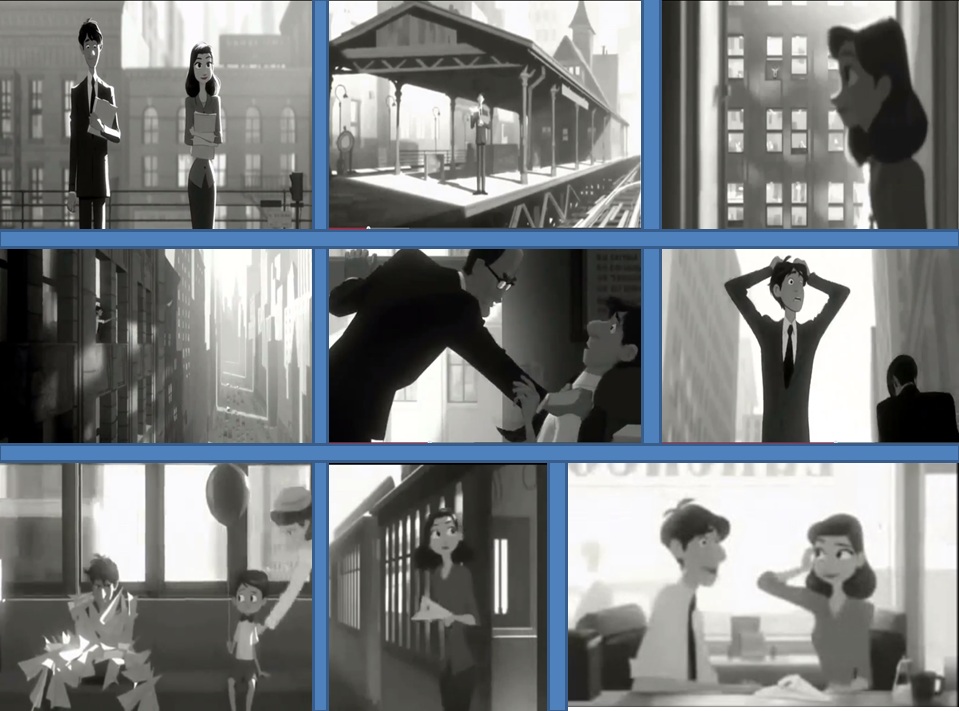
Last week, we spent some time using Movie Talk and the paperman video.  Yesterday, I put up this collage of images from the video and asked students to describe what happened.

hombre de papel collage

My instructions were that they could describe the collage frame by frame or use it as a reference and write from memory of the video.   I told them that they had 5-7 minutes to write.  This activity was not as structured as a timed free write or rubric-based writing assessment.  The students knew that it was just a practice for the type of writing and speaking they’ll have to do on their quarterly final exams soon.  They did not use notes or reference materials.  They had only a blank sheet of paper and the image projected on the screen.  After they finished, a few students shared what they had written, and I collected all of the writings.  Then as a class, we talked through each frame of the collage and students shared as much detail as they could.

The results were impressive.  The writing wasn’t perfect (although a few pieces were incredibly close).  There were some errors in tense mixing, subject verb agreement, adjective use . . . etc.  However, the writing was in Spanish, lots of it.  It was language used spontaneously, in context and it accurately conveyed meaning, lots of it.  The students communicated.  They used the target language.  I was impressed by what they could do, and I believe they were as well.

Perhaps the most impressive part was what didn’t happen.  There were no shouts of, “All in Spanish?  I can’t do that!”  They grumbled a bit at the outset at writing for five minutes (They are still lazy teenagers), but the idea of writing or speaking in Spanish did not intimidate them.  They were almost eager to show what they could do.  What would my textbook-based students of 6 years ago have done?

Why can they produce language?  Because language used in context is what we do everyday.  They constantly hear and read Spanish.  Also, speaking and writing are not foreign concepts.  We do not spend much class time on output tasks.  But when we do, we use the language in context and we focus on communicating.

Sometimes I need an activity like the paperman writing to remind me of what type of students are being developed in my classes.  They are being trained to communicate.

The next logical point is assessment.  If students are being trained to communicate, they should be assessed on their ability to communicate.  Sometimes I get frustrated when I examine my students from a strictly grammatical perspective.  It could be based on a comparison to students of the past or a glimpse of the expectations of other language programs.  Whatever the reason, I find myself informally evaluating my students by measures other than their abilities to communicate in Spanish.  Why?  Grammar is important.  Vocabulary is important.  But they are just components of communication.  I should assess them on their ability to do what we do everyday – communicate.

Posted in Reflections, Uncategorized | 1 Comment

Story script: La muñeca

La muñeca

comía la comida con mucha grasa – used to eat fatty food / was eating fatty food

apareció una muñeca – a doll appeared

(desapareció – disappeared)

“Tú no debes comer eso” – You shouldn’t eat that (+ other infinitives)

PQA ideas:

  1. Bring dolls and describe them
  2. Discuss what restaurants sell fatty foods
  3. Review foods with images and choose “mucha grasa/poca grasa”
  4. “Tú debes” and “Tú no debes” lists for certain situations (at school, at church, before a test . . . etc.)

Había un niño que se llamaba Jorge.  Jorge tenía muchos hábitos malos.  Él comía la comida con mucha grasa.  Él comía en McDonalds y Taco Bell.  Él comía las hamburguesas con tocino y huevos.  Él comía los tacos con pollo frito.  Él nunca comía los vegetales.  Su madre siempre le decía, “Tú no debes comer eso.”  Jorge tomaba Coca Cola y leche de chocolate.  Su madre le decía, “Tú no debes tomar eso.”  Jorge nunca hacía ejercicios.  Él nunca corría.  Él nunca salía afuera.  Él solamente miraba la televisión y comía la comida con mucha grasa.

Un día, Jorge estaba en McDonalds.  Él estaba comiendo tres hamburguesas, las papas fritas, un helado y un Diet Coke.  De repente, apareció una muñeca.  Jorge se asustó y dijo, “Ay dios mío.”  La muñeca era pequeña y extraña y tenía ojos grandes.  La muñeca se llamaba Lucy.  La muñeca dijo (creepy voice), “Tú no debes comer eso.”  La muñeca le quitó una hamburguesa y la comió (point out difference here – comió not comía).  Jorge tenía miedo y dijo, “Yo no voy a comer la comida con mucha grasa.”  La muñeca desapareció.  Jorge empezó a comer y la muñeca apareció.  Él dejó de comer y la muñeca desapareció.  (many times)

Jorge salió de McDonalds y se subió a su carro.   Él empezó a manejar rápido.  La muñeca apareció y dijo, “Tú no debes manejar rápido.”  Jorge empezó a fumar.  La muñeca apareció y dijo, “Tú no debes fumar.”  La muñeca le quitó el cigarrillo.  Jorge fue a la casa de su novia.  Él iba a besarla cuando la muñeca apareció y dijo, “Tú no debes besar a la chica.”  Jorge estaba harto de la muñeca.  Él quería luchar con la muñeca.  La muñeca le dijo, “Tú no debes luchar conmigo.”  Ellos lucharon.  La muñeca ganó.  La muñeca no comió a Jorge porque Jorge llevaba mucha grasa y la muñeca no comía la comida con mucha grasa.


Notes:

*Works best with an old, ragged, creepy doll as a prop.  Every time the doll appears, Jorge should be frightened (horror movie style)

*The first paragraph is designed for a lot of imperfect practice.  It can be lengthened or shortened.

*The second and third paragraphs can be expanded or adapted with any number of activities as long as the doll appears and says, “You should not . . .”  Many reps = great infinitive practice.

Posted in Stories/Storytelling, Story Scripts | 2 Comments

Paperman screenshots for Movie Talk

We did Movie Talk with the paperman video today.  I created a Power Point with screenshots of the video to use for discussion after watching it.  In each class, we watched the video first and then went through the slides and discussed it.  Students enjoyed the video, which held their interest pretty well during the discussion.  There was not much new language during our discussion, mostly just review and describing the scenery and what was happening.

Here is the Power Point.  The video is nearly 6 minutes long, so there are many slides (over 100).  Trying to spend a lot of time on each slide would be torture.  I skipped through some, quickly narrated some and stopped some slides for longer discussion.  The last slide is a collage that students could as a basis for writing or speaking a summary.  I didn’t have time to get to the collage in any classes today.  I’ll probably use it next week.

El hombre de papel


Posted in Movie Talk | 4 Comments